

1. Why People Search “Shown vs Showed”
People search “shown vs showed” because English verb forms collide with modern texting habits. In school, many learned that showed is the past tense of show and shown is the past participle. Then real life happens: texts, DMs, Slack messages, captions, and comments where grammar bends for speed. Suddenly, phrases like “I have showed you” or “I shown him already” appear everywhere—and readers wonder: Which one is correct? Is this slang now? Does context matter?
In 2026, short-form communication dominates. Predictive keyboards, voice-to-text, and global English users amplify confusion. This guide clears it up—precisely and practically—so you’ll know what each form means, when it’s correct, when it’s not, and how to choose confidently across casual chats, work messages, and public writing.
What you’ll learn:
- The exact grammatical difference between shown and showed
- How texting culture affects usage
- When “wrong” forms appear—and why
- Polite, professional, and safe alternatives
- Expert insight into why this confusion persists in 2026
2. What Does “Shown vs Showed” Mean in Text?
Short answer:
- Showed = simple past tense
- Shown = past participle (used with has, have, had)
Literal meanings
- Showed describes a completed action in the past.
- “I showed her the report yesterday.”
- Shown requires a helper verb and connects the action to the present or another past moment.
- “I have shown her the report.”
- “He had shown me the way.”
Implied meaning in texts
- Showed often feels direct and time-bound.
- Shown can imply relevance now (present perfect) or sequencing (past perfect).
When it does NOT mean what people assume
- “I shown you” is not standard English. It’s common in fast typing but grammatically incorrect without a helper verb.
3. Is “Shown vs Showed” a Slang, Typo, or Intentional Usage?
Slang?
Not exactly. Neither shown nor showed is slang. Misuse often looks like slang because it appears frequently in informal chats.
Typo and keyboard influence
- Predictive text sometimes suggests shown after “I have,” then users delete have and forget to change the verb.
- Voice-to-text can drop helper verbs.
Intentional stylistic usage
- Some writers intentionally relax grammar to sound casual or regional. This is style, not correctness.
How to tell by context
- If there’s a helper verb (has/have/had), shown is correct.
- If there isn’t, showed is correct.
4. Origin and Evolution of “Shown vs Showed” in Digital Communication
Early chat & SMS
Character limits encouraged shortcuts. Auxiliary verbs were the first to go, leaving shown stranded without have.
Social media & instant messaging
Speed over precision became normal. Errors spread quickly through imitation.
Younger generations’ influence
Global English users learn through platforms, not textbooks. Patterns circulate faster than rules.
Why it still exists in 2026
- English remains irregular.
- Tools optimize for speed, not grammar.
- Informal spaces tolerate ambiguity.
5. Real-World Usage Scenarios (Detailed Examples)
a) Casual Friend Conversations
- “I showed you that meme last night.” ✅
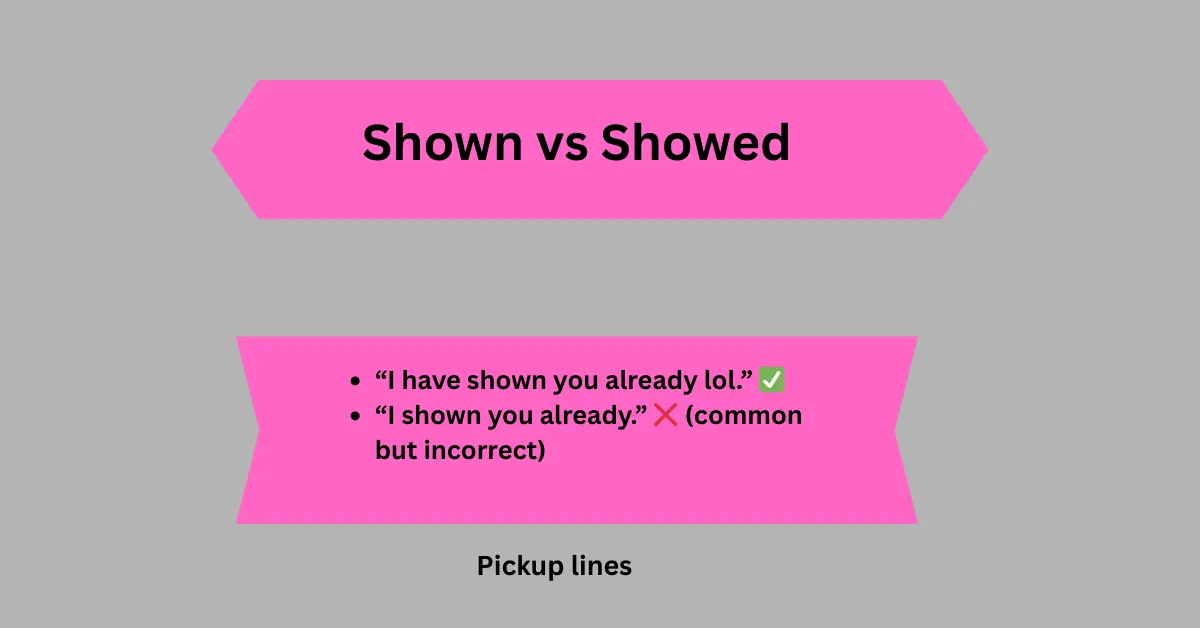
- “I have shown you already lol.” ✅
- “I shown you already.” ❌ (common but incorrect)
Tone: relaxed; errors often ignored.
b) Workplace & Professional Chat
- Informal teams (Slack):
- “I showed the draft to Alex.” ✅
- Formal contexts (email):
- “I have shown the proposal to the client.” ✅
Tone: clarity matters; mistakes can look careless.
c) Social Media, Gaming, Online Communities
- “I showed my build in the last stream.” ✅
- “I have shown it on my profile.” ✅
Tone: casual; correctness varies by community.
6. Emotional Tone and Intent Behind “Shown vs Showed”
Friendly vs neutral vs awkward
- Correct forms feel smooth and confident.
- Incorrect “I shown” can sound rushed or non-native.
Punctuation & emojis
- “I showed you 🙂” feels warm.
- “I have shown you!!!” feels emphatic or defensive.
Warm vs careless
Accuracy signals care—especially in sensitive or professional exchanges.
7. Cultural and Regional Differences in Usage
Native vs non-native speakers
Many languages don’t use auxiliary verbs the same way, leading to shown/showed swaps.
Regional texting habits
Some dialects drop helpers in speech; texting mirrors that.
Cross-platform adoption
TikTok captions ≠ legal emails. Platform norms matter.
8. “Shown vs Showed” Compared With Similar Texting Terms
| Term | Meaning | Tone | Formality | Best Use |
|---|---|---|---|---|
| Showed | Simple past | Neutral | Medium | Past actions |
| Shown | Past participle | Neutral | Medium–High | With has/have/had |
| Displayed | Formal synonym | Formal | High | Reports |
| Sent | Action-focused | Neutral | Medium | Files/messages |
| Shared | Collaborative | Friendly | Medium | Links/media |
9. Common Misunderstandings and Mistakes
- Mistake: “I shown him.”
Fix: “I showed him.” - Mistake: Dropping have unintentionally.
Fix: Keep helper verbs in complete sentences. - Overuse: Repeating shown to sound formal.
Fix: Use showed when simple past is enough.
10. Is “Shown vs Showed” Polite, Rude, or Unprofessional?
Relationship-based
Friends won’t care. Clients might.
Context-based
- Informal chat: flexible
- Professional writing: be correct
Etiquette guidance
When in doubt, choose the grammatically standard form for your sentence structure.
11. Expert Linguistic Insight (Text Language in 2026)
Digital language evolves toward efficiency, not rule-breaking. Abbreviations and omissions persist because they save time. Grammar survives where meaning or credibility matters. Shown vs showed sits right at that boundary.
12. How and When You Should Use “Shown vs Showed”
Do’s
- Use showed for simple past.
- Use shown with has/have/had.
Don’ts
- Don’t use shown alone.
- Don’t assume informal spaces erase all rules.
Safer alternatives
- “I sent you…”
- “I shared it earlier…”
13. FAQs About “Shown vs Showed”
Is “I have showed” correct?
No. It should be “I have shown.”
Is “I shown you” ever correct?
No, not in standard English.
Why do people mix them up so often?
Dropped helper verbs, fast typing, and global usage.
Can I use “showed” in professional emails?
Yes, if it’s simple past and grammatically correct.
Does texting grammar really matter?
It depends on audience and purpose.
Are grammar rules changing in 2026?
Usage evolves, but core verb forms remain stable.
Which is more formal, shown or showed?
Neither inherently—structure determines formality.
14. Final Summary and Key Takeaways
- Showed = simple past
- Shown = past participle with helper verbs
- Texting culture causes confusion, not new grammar
- Correct usage boosts clarity and credibility
- Match your choice to context, audience, and intent
Mastering shown vs showed isn’t about being picky—it’s about being understood.