

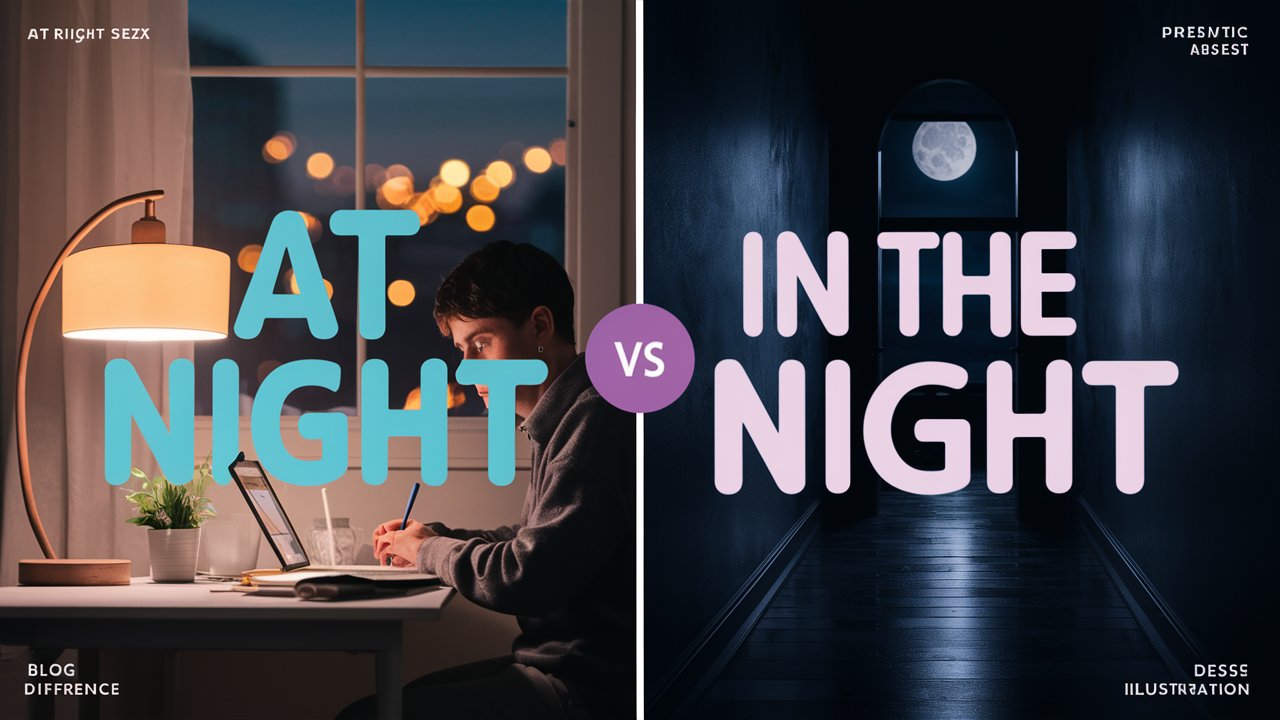
You’ve seen both. You’ve probably used both. But which one is actually correct: at night or in the night?
This small grammar detail creates big confusion. It shows up in emails, essays, captions, and even professional reports. Many learners assume they’re interchangeable. They’re not.
The truth is simple once you understand the pattern.
In this complete guide, you’ll learn:
- The exact difference between at night and in the night
- When each one is correct
- Why English uses different prepositions
- Common mistakes to avoid
- Professional usage rules
- How this confusion relates to grammar issues like arised or arose
Let’s fix it clearly and permanently.
What Is the Difference Between “At Night” and “In the Night”?
Here is the short answer:
- At night = nighttime in general (habit or routine)
- In the night = something happened during one specific night
That’s the core rule.
Examples:
✔ I work at night.
✔ It gets quiet at night.
✔ I feel more creative at night.
These describe general or repeated behavior.
Now compare:
✔ I heard a strange noise in the night.
✔ She woke up suddenly in the night.
✔ Something moved outside in the night.
These describe one event during one particular night.
Why People Get Confused
English prepositions don’t always follow logical patterns.
We say:
- In the morning
- In the afternoon
- In the evening
So many learners assume:
- In the night
But English uses a fixed expression:
- At night
This is called an idiomatic time expression. It doesn’t follow strict logic. It follows usage tradition.
This confusion is similar to grammar mistakes like:
- arised or arose
- arose or arised
- is arised a word
Just like arised is incorrect and arose is correct, only one phrase fits depending on context.
Grammar works by pattern, not guesswork.
Quick Comparison Table
| Phrase | Meaning | Usage Type | Tone |
|---|---|---|---|
| At night | Nighttime in general | Habit / routine | Neutral |
| In the night | During one specific night | Single event | Slightly narrative |
| During the night | Specific timeframe | Formal / reports | Professional |
| Overnight | Time span | Business / neutral | Professional |
If you remember nothing else, remember this:
👉 Habit = at night
👉 Event = in the night
When to Use “At Night”
Use at night when you’re talking about:
- Regular behavior
- Schedules
- General nighttime conditions
- Repeated actions
Examples:
- I usually study at night.
- The temperature drops at night.
- I can’t drive well at night.
- Owls hunt at night.
Notice something?
These are not about one night. They describe patterns.
That’s why “at” works here. English uses at for general time points:
- At noon
- At midnight
- At night
When to Use “In the Night”
Use in the night when describing:
- A specific event
- Something that happened during one particular night
- A storytelling situation
- A dramatic or descriptive moment
Examples:
- A scream echoed in the night.
- The baby cried in the night.
- A storm began suddenly in the night.
- Something felt different in the night.
“In the night” sounds slightly more literary. You’ll see it more often in:
- Novels
- Stories
- Narratives
- Descriptive writing
It focuses on an incident inside that night.
Tone Difference: Neutral vs Narrative

This is where most grammar blogs stop. But tone matters.
“At night” feels:
- Neutral
- Informational
- Everyday
- Practical
Example:
I work at night.
It sounds factual.
“In the night” feels:
- Dramatic
- Cinematic
- Story-based
- Slightly emotional
Example:
A shadow moved in the night.
It sounds like storytelling.
That’s why native speakers prefer “at night” in daily speech and “in the night” in narratives.
Professional & Workplace Usage
Clarity matters in professional settings.
Correct Business Usage
Routine:
- Our system runs backups at night.
Specific event:
- A system error occurred in the night between 2–3 AM.
- The incident happened during the night shift.
In formal reports, “during the night” is often safer and clearer than “in the night.”
Professional communication values precision over style.
Common Mistakes to Avoid
❌ Mistake 1: Using “In the Night” for Habits
Incorrect:
- I brush my teeth in the night.
Correct:
- I brush my teeth at night.
❌ Mistake 2: Redundant Phrases
Incorrect:
- At night time
Correct:
- At night
“Night time” is unnecessary.
❌ Mistake 3: Mixing Structures Randomly
Incorrect:
- I wake up in the night every day.
Correct:
- I wake up at night.
Because it’s repeated.
Is “In the Night” Wrong?
No.
It’s correct. But only in specific contexts.
The problem isn’t grammar. The problem is usage.
Just like:
- “Arised” sounds possible but is wrong.
- “Arose” is correct.
Context decides everything.
Why English Uses “At Night”
English time prepositions follow patterns:
- At → precise or fixed time expressions
- In → longer enclosed time periods (months, years, seasons)
- On → specific days
Night is treated like a time point, not a long duration. That’s why we say:
- At night
- At midnight
- At dawn
Even though night lasts hours, English treats it grammatically like a time marker.
Language doesn’t always follow logic. It follows tradition.
Cultural & Global Usage Differences
Non-native speakers often overuse “in the night” because their language uses a direct translation pattern.
Native speakers:
- Prefer “at night” in speech
- Use “in the night” more in writing or storytelling
British English may use “in the night” slightly more often in descriptive writing than American English, but both follow the same rule.
Modern Digital Communication (2026 Context)
Texting culture favors:
- Shorter structures
- Simpler expressions
- Reduced ambiguity
That’s why “at night” dominates in:
- Instagram captions
- Slack messages
- SMS
“In the night” appears mostly in:
- Creative posts
- Horror threads
- Emotional storytelling
Efficiency drives language online.
How to Decide Instantly (Simple Rule)
Ask yourself:
Is this about something that usually happens?
Yes → Use at night
Is this about something that happened once?
Yes → Use in the night
If unsure in professional writing:
Use:
- During the night
- Overnight
They are clearer and safer.
FAQs
1. Is “in the night” grammatically correct?
Yes. It is correct when describing a specific event during one night.
2. Why do people say “at night” more often?
Because it refers to nighttime in general, which is more common in daily conversation.
3. Is “at night time” wrong?
Yes. It’s redundant. Just say “at night.”
4. Which sounds more natural?
“At night” sounds more natural in everyday speech.
5. Can I use “in the night” in emails?
Only when describing a specific incident. Otherwise use “at night” or “during the night.”
6. Is this similar to “arised or arose” confusion?
Yes. Only one structure fits depending on grammar rules. “Arised” is incorrect. Context determines correct form.
7. Do native speakers use both?
Yes, but “at night” is much more common.
8. Is one more formal than the other?
Not exactly. “During the night” sounds more formal than both.
Final Summary
Both at night and in the night are correct.
But they are not interchangeable.
- At night describes general, habitual nighttime situations.
- In the night describes a specific event during one particular night.
Most daily communication requires “at night.”
“In the night” belongs more in storytelling or incident descriptions.
If you remember one rule, remember this:
Habit = at night
Event = in the night
Master this difference and your English immediately sounds more natural, precise, and confident.