

People search “anyway or anyways” because they keep seeing both forms used everywhere—texts, tweets, comments, emails, and even workplace chats—and they want a clear answer.
Is one correct?
Is the other slang?
Does it sound rude?
Does it change meaning in text messages?
The confusion has grown in recent years because modern digital communication rewards speed, tone, and familiarity over strict grammar. In texting and social platforms, people often write how they speak. That habit blurs the line between standard English and accepted informal usage.
In 2026, language online moves faster than grammar books. Autocorrect, predictive text, and social influence shape how words appear on screens. That is why readers want more than “right vs wrong.” They want context, intent, tone, and real-world guidance.
In this guide, you will learn:
- The exact meaning of anyway and anyways
- Why both exist and why people mix them up
- How tone changes across texting, work, and social media
- Whether anyways is rude, sloppy, or acceptable
- When to use each safely—and when not to
This article focuses on how English is actually used today, not just how it was taught.
2. What Does “Anyway or Anyways” Mean in Text?
At its core, anyway is an adverb. It means:
- Regardless
- In spite of that
- Moving on from the previous point
Example:
“It’s raining, but I’m going anyway.”
In texting, anyway often signals a shift in topic or decision:
“I don’t think he’ll reply. Anyway, what are you doing tonight?”
What about “anyways”?
Anyways carries the same intended meaning, but with an added informal tone. It reflects how many people naturally speak, especially in casual conversation.
Important distinction:
- Meaning: same as anyway
- Formality: lower
- Perception: conversational, sometimes careless
When it does NOT mean what people assume
Some assume anyways adds emphasis or plural meaning. It does not. The “s” does not change the definition. It only changes tone and formality.
3. Is “Anyway or Anyways” a Slang, Typo, or Intentional Usage?
This is where most misunderstandings happen.
Slang usage
Anyways is often labeled as slang, but that is only partly true. It is better described as nonstandard but established informal usage.
It appears frequently in:
- Casual speech
- Text messages
- Online comments
- Gaming and Discord chats
Typing behavior and keyboard influence
Predictive text sometimes suggests anyways because it appears frequently in datasets based on conversational English. This reinforces its use, especially among younger users.
Intentional stylistic choice
Many people use anyways on purpose to sound:
- More relaxed
- Less formal
- More friendly
How to tell the difference using context
Ask these questions:
- Is this a formal setting?
- Is the message professional or casual?
- Is the writer shifting tone intentionally?
If the answer points to casual conversation, anyways is likely intentional.
4. Origin and Evolution of “Anyway or Anyways” in Digital Communication
Early chat and SMS influence
In early SMS and chat rooms, people typed exactly how they spoke. Regional speech patterns entered written form without editing. Anyways appeared naturally because many speakers already said it aloud.
Social media and instant messaging evolution
Platforms like Twitter, WhatsApp, and Instagram normalized spoken-style writing. Grammar loosened. Tone became more important than correctness.
How younger generations shaped usage
Gen Z and Gen Alpha prioritize:
- Speed
- Authenticity
- Emotional tone
They care less about grammar rules that do not affect meaning.
Why it still exists in 2026
Because it works. Anyways communicates:
- Casual transition
- Low-stakes conversation
- Friendly disengagement
Language keeps what people use.
5. Real-World Usage Scenarios (Detailed Examples)
a) Casual friend conversations
Here, anyways feels natural.
Examples:
“I’m tired anyways lol.”
“Didn’t matter anyways.”
Tone:
- Relaxed
- Informal
- Non-judgmental
Using anyway would also be correct, but slightly more neutral.
b) Workplace and professional chat (formal vs informal teams)
Formal workplace
Use anyway.
Example:
“Anyway, let’s move forward with the proposal.”
Informal or startup teams
Both appear, but anyway is safer.
Example:
“Anyways, I’ll fix it tomorrow.”
This may sound careless to some readers.
Tone shifts matter more than grammar here.
c) Social media, gaming, and online communities
Anyways is common and accepted.
Examples:
“Lost the match anyways.”
“Didn’t care anyways gg.”
Tone:
- Casual
- Peer-based
- Emotion-driven
In these spaces, anyway can feel stiff.
6. Emotional Tone and Intent Behind “Anyway or Anyways”
Tone matters more than the word itself.
Friendly vs neutral vs awkward
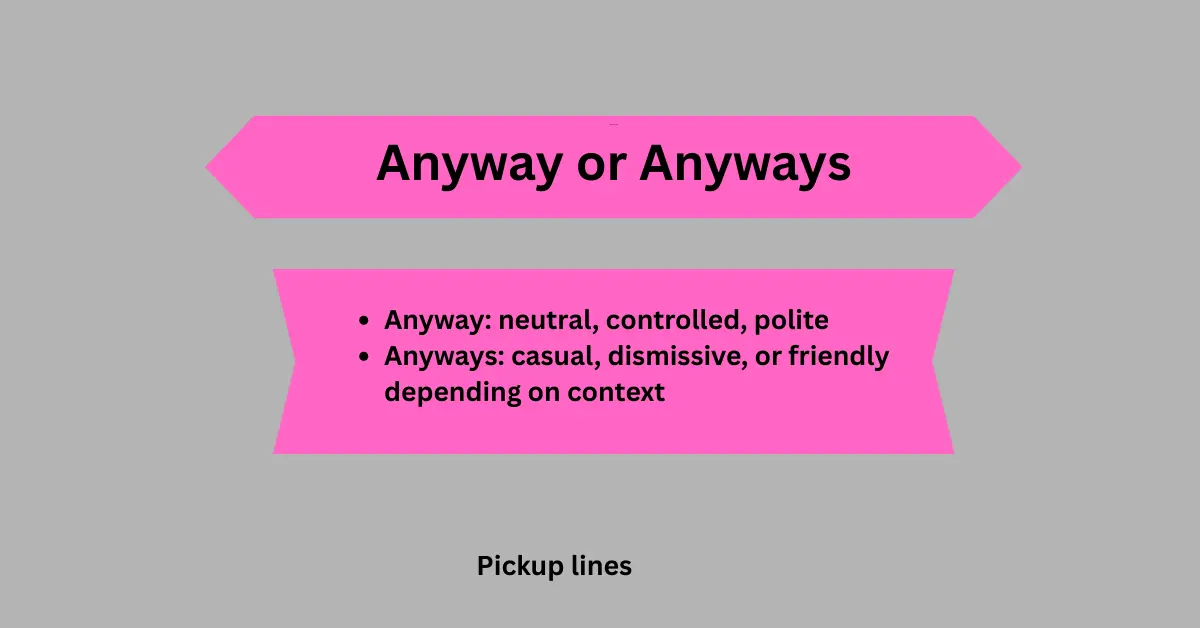
- Anyway: neutral, controlled, polite
- Anyways: casual, dismissive, or friendly depending on context
How punctuation and emojis change meaning
Compare:
“Anyway.”
Sounds final or dismissive.
“Anyways 😊”
Sounds friendly and soft.
“Anyways…”
Sounds reluctant or awkward.
When it feels warm vs careless
- Warm: paired with emojis, explanations, or humor
- Careless: used abruptly in serious discussions
7. Cultural and Regional Differences in Usage
Native vs non-native English speakers
Non-native speakers are often taught that anyways is incorrect. This makes them more cautious and more likely to use anyway exclusively.
Regional texting habits
- North American English uses anyways more frequently
- British English strongly prefers anyway
Cross-platform language adoption
TikTok, YouTube, and gaming culture spread informal forms globally, even where traditional rules differ.
8. “Anyway or Anyways” Compared With Similar Texting Terms
| Term | Meaning | Tone | Formality | Best Use Case |
|---|---|---|---|---|
| anyway | regardless, moving on | neutral | medium | work, writing |
| anyways | same meaning | casual | low | texting |
| regardless | despite something | serious | high | formal writing |
| moving on | topic shift | polite | medium | meetings |
| still | continuation | neutral | medium | explanation |
LSI and semantic relatives:
- regardless
- in any case
- either way
- still
- moving on
9. Common Misunderstandings and Mistakes
Misinterpretation cases
People often read anyways as dismissive when the writer meant friendly closure.
Autocorrect and keyboard issues
Autocorrect may insert anyways even when you typed anyway. Always double-check in professional messages.
Overuse problems
Repeated use can make writing feel lazy or rushed.
How to avoid confusion
- Use anyway in unclear contexts
- Add context or punctuation
- Avoid abrupt endings
10. Is “Anyway or Anyways” Polite, Rude, or Unprofessional?
Relationship-based analysis
- Friends: both fine
- Strangers: anyway is safer
- Authority figures: avoid anyways
Context-based analysis
The same word can sound polite or rude depending on timing and tone.
Example:
“Anyway, thanks for your help.”
Polite.
“Anyways.”
Abrupt and dismissive.
Professional etiquette guidance
If in doubt, choose anyway. It never harms credibility.
11. Expert Linguistic Insight (Text Language in 2026)
Digital language evolves through efficiency and emotional signaling. Abbreviations and informal variants survive because they:
- Reduce effort
- Increase relatability
- Match spoken rhythm
Grammar rules adapt slowly. Usage adapts instantly. That gap explains debates like anyway or anyways.
12. How and When You Should Use “Anyway or Anyways”
Do’s
- Use anyway in writing, emails, and work chat
- Use anyways in casual texting if tone fits
- Read the room before choosing
Don’ts
- Do not use anyways in formal documents
- Do not end serious messages abruptly with either
- Do not overuse as a filler word
Safer alternatives
- “In any case”
- “Either way”
- “Moving on”
13. FAQs About “Anyway or Anyways”
Is “anyways” grammatically correct?
It is nonstandard but widely accepted in informal English.
Which is correct in writing?
Anyway is preferred in all formal writing.
Is “anyways” rude?
Not inherently. Tone and context decide.
Do native speakers use “anyways”?
Yes, especially in casual speech and texting.
Is “anyways” American English?
It is more common in North American usage.
Should I avoid it at work?
Yes, unless the environment is very informal.
Does it change meaning?
No. Only tone and formality change.
14. Final Summary and Key Takeaways
- Anyway and anyways share the same meaning
- Anyway is standard, neutral, and professional
- Anyways is informal and conversational
- Tone, context, and audience matter more than grammar rules
- When unsure, choose anyway
Understanding how people actually read tone in digital spaces matters more than memorizing rules. Language works best when clarity and respect come first.