

Organic chemistry, often abbreviated as “Orgo,” has its own unique language. Beyond the standard chemical formulas and reaction mechanisms, students have developed a fun and quirky set of slang terms to describe molecules, reactions, and lab experiences. This blog explores what Orgo slang is, where it comes from, and how it’s used by students worldwide.
What Is Orgo Slang?
Orgo slang refers to informal, humorous, or shorthand terms used by organic chemistry students and professionals to describe chemical reactions, lab equipment, molecules, and sometimes the emotional struggles of studying the subject. These terms often simplify complex concepts or make them more memorable, helping students relate to the material in a more casual and engaging way.
The Origins of Orgo Slang
The origins of Orgo slang can be traced back to university labs and classrooms, where students faced the challenging and abstract nature of organic chemistry. To make memorization and communication easier, students began creating nicknames for common reactions (like “Sn2” being jokingly called “backside attack”) or reagents (like “grignard” reagents being referred to as “GR-lords”). Over time, these terms spread through word-of-mouth, textbooks, memes, and online forums like Reddit and TikTok, becoming part of the organic chemistry subculture.
Why Students Use Orgo Slang
Students use Orgo slang for several reasons:
- Memory Aid: Humorous or catchy terms make it easier to remember reactions and mechanisms.
- Community Building: Shared slang creates a sense of belonging among students tackling the notoriously difficult subject.
- Stress Relief: Organic chemistry can be stressful, and joking about it using slang adds a lighthearted element.
- Efficiency: Short terms can speed up communication in labs, study groups, and online discussions.
Core Orgo Slang Terms and Their Meanings
Here are some widely recognized Orgo slang terms:
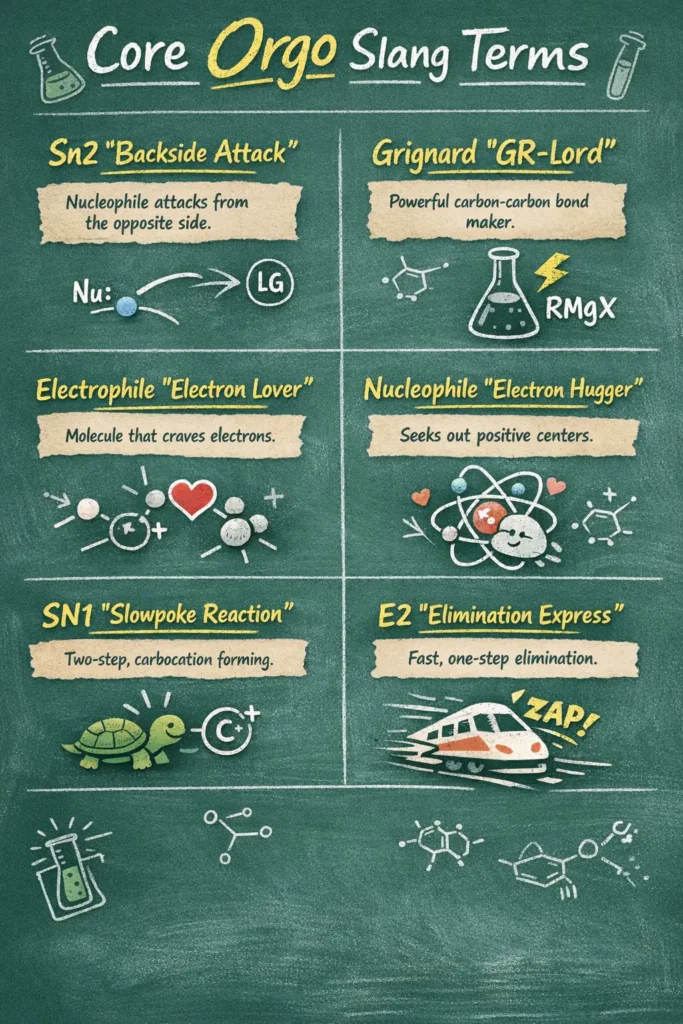
- Sn2: Referred to as a “backside attack” because the nucleophile attacks from the opposite side of the leaving group.
- Grignard Reagent: Sometimes called “GR-lord” because of its powerful ability to form carbon-carbon bonds.
- Electrophile: Often joked about as a “love-attracting molecule” because it seeks electrons.
- Nucleophile: Nicknamed the “electron lover” due to its attraction to positive centers.
- SN1: Referred to as the “slowpoke reaction” because of its multi-step, carbocation-forming mechanism.
- E2 Reaction: Sometimes called the “elimination express” because it happens in one concerted step.
Related Terms and Alternatives
Beyond the core slang, there are additional terms and playful alternatives students use:
- “Orgo Tears” – The emotional breakdowns students experience during exams or tough labs.
- “Carbocation drama” – Refers to the instability of carbocations in reaction mechanisms.
- “Radical party” – Describes reactions involving free radicals.
- “Mechanism marathon” – Long sessions spent figuring out complex reaction steps.
Orgo Slang in Action: Real Examples
- “I was stuck on this Sn1 last night, total slowpoke reaction, but the carbocation drama made it exciting.”
- “Don’t forget your GR-lord in the lab; it’s the electron lover’s best friend.”
- “Organic chem exam tomorrow… time for a mechanism marathon and some Orgo tears.”
These sentences show how slang blends humor with the technical language of chemistry.
The Cultural Impact of Orgo Slang
Orgo slang isn’t just for jokes—it has become a part of the organic chemistry culture. Online memes, TikTok videos, and Reddit threads use these terms to share struggles and successes. The slang helps normalize the challenges of the subject, creating a supportive and fun community among students worldwide.
When and How to Use Orgo Slang
- Study Groups: Perfect for casual discussions and memorization.
- Social Media: Memes, TikToks, and Reddit posts thrive on this language.
- Labs (Informally): Among peers, it can make communication quicker and more enjoyable.
Tip: Avoid slang in formal reports, exams, or professional presentations—it’s fun but not academically acceptable in formal contexts.
How to Respond to Orgo Slang
When someone uses Orgo slang, you can:
- Laugh and relate if you understand it.
- Ask for clarification if you’re new—it’s a learning opportunity.
- Share your own slang to join the community.
Common Misconceptions
- It’s unprofessional: Not always—slang is meant for informal contexts.
- It’s confusing: Most terms are designed to simplify, not complicate.
- It replaces real learning: Slang complements, but does not replace, proper study and understanding.
Frequently Asked Questions
Can I use Orgo slang professionally?
Only in informal, peer-to-peer settings. Avoid using it in academic papers or presentations.
How did Orgo slang become popular online?
Through student forums, Reddit threads, TikTok videos, and meme culture sharing lab struggles humorously.
What is the exact Orgo definition?
“Orgo” is short for organic chemistry, which studies carbon-containing compounds and their reactions.
Are there equivalents in other subjects?
Yes! Physics, biology, and math all have their own student-created slang and memes.
Can Orgo slang help me study or remember concepts?
Absolutely! Associating humor or memorable imagery with reactions makes it easier to recall complex material.
Conclusion
Orgo slang is more than just jokes—it’s a creative way for students to cope with and understand the challenging world of organic chemistry. From “backside attacks” to “GR-lords,” these terms lighten the learning load, build community, and make the subject a little less intimidating. Embrace the slang, but remember to switch back to formal language when it counts.