

Small grammar mistakes can create big confusion. One of the most common errors in everyday English is writing “to early” instead of “too early.” It appears in emails, social media posts, and even professional writing.
At first glance, the difference seems minor. But in reality, these two forms follow completely different grammar rules. Understanding them will instantly improve your clarity, credibility, and writing quality.
This complete guide breaks everything down in a simple, practical way so you never make this mistake again.
Why “To” vs “Too” Causes Confusion
Why it happens
The confusion exists because “to” and “too” sound exactly the same. They are homophones, meaning they share pronunciation but have different meanings and spellings.
English is full of these tricky pairs. When people rely on sound instead of structure, mistakes happen.
Another reason is speed. In texting or casual writing, people type quickly and skip proofreading. That leads to errors like:
- “It’s to early to decide”
- “I woke up to early today”
These mistakes stick if not corrected early.
Real-world example
Consider this sentence:
- “It’s too early to leave.”
Now compare it with:
- “It’s to early to leave.”
The first sentence is correct and clear. The second feels awkward and grammatically broken. Even if the meaning is guessed, the sentence loses professionalism.
What “To” Really Means
The word “to” is one of the most commonly used words in English. It has several important functions:
1. Preposition
It shows direction, place, or relationship.
- I am going to the store
- She gave the book to him
2. Part of an infinitive verb
It combines with a verb to express an action.
- I want to eat
- They plan to travel
3. Expressing range or limit
- From 9 to 5
- 10 to 20 people attended
In all these uses, “to” does not intensify or modify adjectives. That’s the key point.
The Power of “Too” as an Intensifier
The word “too” has a completely different role. It acts as an adverb, often used to add emphasis.
It has two main meanings:
1. Meaning “also” or “as well”
- I want to go too
- She likes coffee too
2. Meaning “excessively” or “more than needed”
This is where confusion with “early” happens.
- It’s too cold outside
- This bag is too heavy
Here, “too” intensifies the adjective.
Examples
- It’s too late to call
- This task is too difficult
- He arrived too early
In each case, “too” adds the idea of excess or undesirability.
Breaking Down the Phrase “Too Early”
Literal meaning
“Too early” means earlier than expected, required, or appropriate.
- I woke up too early
- It’s too early to start the meeting
It suggests something is happening before the ideal time.
Figurative meaning
Sometimes, “too early” is used in a broader sense.
- It’s too early to judge the results
- It’s too early to celebrate success
Here, it doesn’t refer to time on a clock. Instead, it refers to timing in a process or situation.
Why “To Early” Is Incorrect in Standard Grammar
“To early” is grammatically incorrect because:
- “To” cannot modify adjectives like “early”
- The sentence lacks an intensifier
- The structure becomes incomplete
Let’s analyze:
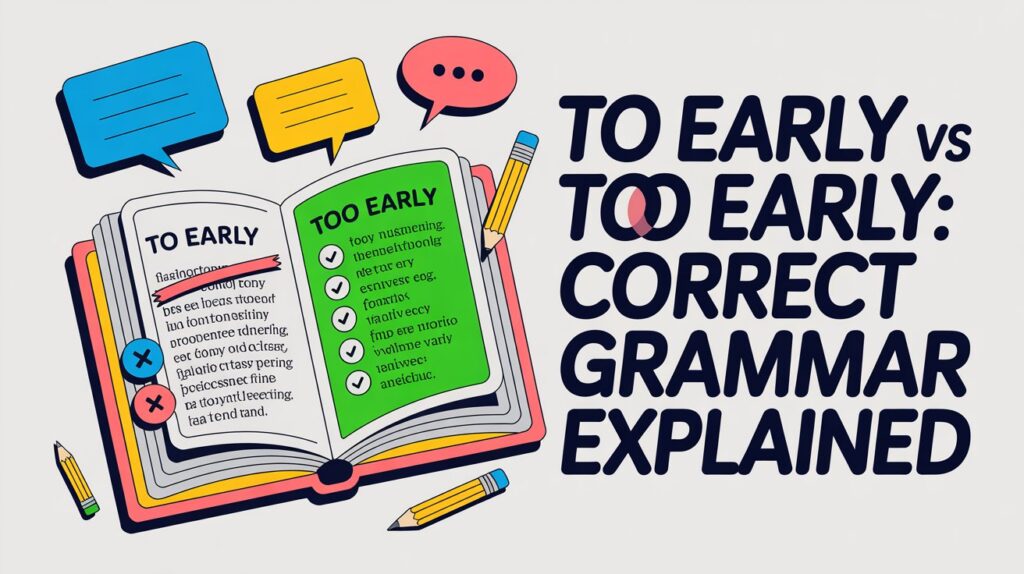
❌ It’s to early
✔ It’s too early
In the correct sentence, “too” modifies “early.” Without it, the sentence loses meaning.
Think of it this way:
- “Too” = adds emphasis
- “To” = connects or directs
They are not interchangeable.
Practical Examples: “To” vs “Too” with Early
Correct usage:
- It’s too early to wake up
- You arrived too early for the event
- It’s too early to make a decision
Incorrect usage:
- It’s to early to wake up
- You arrived to early
- It’s to early to decide
Now compare a sentence using both correctly:
- I woke up too early to catch the train
Here:
- “Too” modifies “early”
- “To” introduces the verb “catch”
This is a perfect example of how both words can appear together but serve different roles.
Tips for Remembering the Difference
Mnemonics
A simple trick:
- “Too” has an extra ‘o’ — think of it as extra emphasis
If something is excessive, you need that extra “o.”
Memory Tip Table
| Word | Meaning | Example |
| To | Direction or verb marker | Go to sleep |
| Too | Excess or also | Too early to start |
Practice Exercise
Fill in the blanks:
- It’s ___ early to leave
- I want ___ go home
- She arrived ___ early
Answers:
- too
- to
- too
Practice like this helps reinforce the pattern quickly.
Advanced Cases: When “To” and “Too” Appear Near Each Other
Common structures
You will often see sentences like:
- It’s too early to decide
- He is too tired to work
- She is too young to drive
This structure is extremely common in English.
Grammar pattern
The pattern looks like this:
Too + adjective + to + verb
Example:
- Too early to start
- Too late to change
- Too busy to respond
Understanding this structure eliminates confusion completely.
Insights from Grammar Experts and Style Guides
Major grammar authorities consistently agree:
- “Too” must be used when modifying adjectives
- “To” should only function as a preposition or verb marker
Style guides emphasize clarity. Using “to early” breaks standard grammar rules and can affect readability.
Professional writing demands precision. Even small errors like this can reduce trust in your content.
Quick Reference Table: “To” vs “Too”
| Feature | To | Too |
| Part of speech | Preposition / infinitive marker | Adverb |
| Function | Connects or directs | Adds emphasis |
| Works with adjectives | No | Yes |
| Example | To go | Too early |
This table gives you a quick way to check your usage anytime.
Common Mistakes and How to Avoid Them
Why mistakes happen
- Similar pronunciation
- Fast typing habits
- Lack of proofreading
- Weak grammar fundamentals
These factors combine to create frequent errors.
How to fix it
- Slow down when writing important text
- Read sentences aloud
- Look for adjectives like “early,” “late,” “fast”
- Ask: “Do I mean excessive?”
If yes, use “too.”
Case Study: Social Media Grammar Slip-Ups
Social media platforms are full of grammar mistakes. One of the most common is “to early.”
Example post:
- “It’s to early for this meeting”
While most readers understand the message, the mistake affects perception.
In professional contexts like:
- LinkedIn posts
- Business tweets
- Brand messaging
These errors can damage credibility.
Brands that maintain clean grammar appear more trustworthy and authoritative.
Summary and Final Thoughts
The difference between “to early” and “too early” comes down to one simple rule:
- Use “too” when you mean excess or more than needed
- Use “to” for direction or verbs
“Too early” is correct because it modifies the adjective “early.”
“To early” is always incorrect in standard English.
Mastering this small distinction can significantly improve your writing clarity and professionalism.
FAQs
What is the correct phrase: “to early” or “too early”?
The correct phrase is “too early.” “To early” is grammatically incorrect.
Why is “too early” correct in English grammar?
Because “too” acts as an adverb that modifies the adjective “early,” indicating excess.
Can “to” ever be used before “early”?
Yes, but only in a different structure:
- I want to arrive early
Here, “to” is part of the verb phrase, not modifying “early.”
Are “to” and “too” homophones?
Yes, they sound the same but have different meanings and spellings.
Is it “too early to tell” or “to early to tell”?
The correct phrase is:
- Too early to tell
Conclusion
Getting “to” and “too” right is one of the easiest ways to improve your English instantly. The rule is simple, but the impact is powerful.
Every time you write:
- Emails
- Articles
- Social media posts
You are communicating not just ideas, but also attention to detail.
Remember:
- “Too” carries emphasis
- “To” connects actions
Once you understand that difference, you won’t second-guess yourself again.